Off Center

Will Corporate Bonds Become the Real AI Bottleneck?
Soundbite: We continue to be surprised by the ever-rising increase in hyperscalers’ capital expenditures. In January, the forecasted spike from 2025’s $400 billion data center outlay pushed average capex/cash flow ratio forecasts to 70% for Microsoft, Amazon, Google, and Meta. After last Wednesday’s quarterly earnings, we discovered planned capital spending through December will hit $750 billion, inflating the capex/cash flow ratio to a colossal 92%. Apparently, these companies have not hit peak capex because capital outlays of $850 billion are scheduled for 2027 (Morgan Stanley just rolled out a $1.1 trillion 2027 forecast). The potential bottlenecks in power and memory chips are already increasing capital costs, but the ultimate constraint may be the exploding interest costs that will burden hyperscalers’ balance sheets as they are forced to increasingly overwhelm the public and private corporate bond market to finance their projects.
Our worst case is that we may be entering an environment of “doom loops” not only in the Treasury market, but in the corporate bond market as well, where exploding capex costs that exceed operating free cash flow could also cause a crowding out. As we wrote two weeks ago, “Escalating interest payments against a backdrop of mounting budget deficits have increased the possibility of a ‘doom loop,’ where investors demand higher Treasury yields, widening the budget deficit, which calls for even greater Treasury issuance and pushes rates even higher.” If the AI race proves to be nothing more than a commoditized business that caps return on investment, we are worried that hyperscalers and their lenders risk getting caught in a downward debt spiral along with the U.S. government.
Microsoft announced it is diversifying away from OpenAI, supporting our long-standing argument that there is no product differentiation across the hyperscalers in AI, in stark contrast to their legacy businesses. Stock investors are already looking for hyperscalers’ core businesses to pick up the slack while AI spending continues to drain cash flow. At some point, returns on AI capex will be scrutinized in the same way, and if excess data center capacity emerges, these firms, and the entities who fund them, are vulnerable to a negative re-rating.
Jefferies analysts are concerned with the constant increase in compute, memory, and power costs that hyperscalers have convinced themselves are necessary to remain competitive. The investment bank concluded that the result will be that “sustainable profitability is far away for pure model players,” which runs contrary to red-hot investor optimism.
Supply chain shortages for memory chips have pushed prices higher, lifting overall capex numbers even more than anticipated. This has helped raise the 70% capex/operating free cash flow ratio for 2026 to 90% in the span of only three months. These enterprises have hit the point where they may need to turn to heavy outside debt issuance.
Two threads have taken hold that could pose an enormous headwind for risk assets if left unchecked. As just mentioned, we expect the hyperscalers will need to tap credit markets, but we hope they don’t follow Meta’s lead too closely. Meta Platforms turned to debt markets last October with a $30 billion offering, and the firm announced plans last week for an additional debt raise that could reach $25 billion. These are enormous sums to absorb. Secondly, we hope that other modelers avoid OpenAI’s predicament. Sam Altman’s firm must increase revenues tenfold by 2030 to pay for their circular compute deals. Specifically, they need to either generate or raise $850 billion, and if they cannot start hitting sales targets, they must rely increasingly on debt financing.
If it becomes clear that other AI modelling companies are entering price wars and facing escalating costs, they may pressure debt markets, pushing rates higher and credit spreads wider.
The current euphoria binge party may turn in on itself.
The Three Amigos!
Soundbite: Last week’s FOMC statement revealed undercurrents, as the three most hawkish voters on the Committee—Presidents Kashkari of Minneapolis, Logan of Dallas, and Hammack of Cleveland—objected to keeping language suggesting the next move would be a rate cut. The other nine voters stayed quiet, as Chair Powell explained: “The center is moving toward a more neutral place…There is a lot of signaling going on when you change guidance like that. A majority of us didn’t feel it was necessary to send a signal…Maybe it will come to that.” We believe it would be a mistake for investors to assume nothing significant occurred.
Fed funds futures now reflect only a 1% probability of a 2026 rate hike, rising to 25% for a hike within one year. We recommend equity investors follow this metric and track the changes in the timing and probability of a rate hike that we believe may happen. Certainly, in dissenting, the three voters believe the FOMC should “offer a policy outlook that the next change could be either a cut or a hike.” This is a natural progression to what we discussed two weeks ago, when we wrote, “We have been expecting the Fed’s tone to shift toward acknowledging the possibility of rate hikes. Waller’s comments on Friday only strengthen our expectations.” The speed with which markets move toward our view will determine the potential of a long-term trend change in equities.
Ironically, the dissenters may appear to superficially support the incoming Chair’s stance that forward guidance locks in stale thinking. While their underlying message is that current forward guidance is obsolete in light of yet another supply shock, they merely want to update the language of forward guidance, not abandon its practice.
Because the trio of objections was driven by recognizing the significance of forward guidance, we expect Warsh to face a philosophically combative FOMC. Neel Kashkari described forward guidance as “itself an instrument of monetary policy.” In explaining her dissent, Lorie Logan concluded:
“When the FOMC gives forward guidance about the likely course of future interest rates…It influences financial conditions and the economy, and it affects the achievement of the FOMC’s maximum employment and price stability goals. Equally, households and businesses rely on the guidance to make future plans.”
In her statement, Dallas Fed President Logan revealed a more important upcoming battle over the future path of inflation. Both Warsh and Logan share a preference for median inflation measures; she relies on “measures of inflation that strip out extreme price changes or categories where prices are more volatile.” Unfortunately for Warsh, who points to trimmed inflation as a reason to cut rates, Logan uses the same data to argue the opposite: “Even before recent increases in the prices of energy and other commodities, those measures had been running meaningfully above 2 percent, leaving doubts about how long it will take inflation to return to target.”
Beth Hammack shared similar language with Kashkari and Logan in her separate comments, writing “Inflation pressures continue to be broad based, and rising oil prices present an additional source of inflationary pressure.” Brace for some split decisions and a frustrated administration.
Buffett Indicator: 6-7
Soundbite: Warren Buffett’s famous stock market valuation indicator of U.S. total market cap divided by GDP just hit a new high of 2.3x. The indicator famously hit an all-time high of 1.4x at the March 2000 tech bubble peak and revisited that level in January 2018, when investors learned about “Volmageddon,” a vicious feedback loop that accelerated that market selloff. However, since then, the Buffett indicator seems to have reset, prompting some analysts to question whether the GDP denominator is as valuable a metric in a world where technology and data are the driving force, not manufacturing. We do not think the indicator is obsolete but attribute the valuation reset to enormous fiscal stimulus.
We remember when Buffett was considered out of touch in 1999, so we are not dismissing the indicator as nonsense. While the Market Cap to GDP ratio has undergone a regime shift, other metrics also seem to have entered a new world: the S&P price-to-sales ratio hit 3.3x versus the 2000 peak of 2.3x. We caution against a view that “things are different now.”
Berkshire Hathaway’s annual shareholder meeting grabbed headlines when new CEO Greg Abel brought up the potential for an inflation scenario of 8-9 percent. While that is not a base case, the fact that it was mentioned shows it is a right-tail possibility that investors should consider in their positioning. Berkshire has been raising cash for three and a half years and now holds $400 billion in Treasury Bills, which should not be easily dismissed by investors.
In the chart of the Buffett indicator going back to 1970, we highlight the 2000 and 2018 peaks and also note when the indicator fell back to those old highs at major market lows in October 2022. The new floor may be the historic 1.4-1.5x highs, which is still a scary proposition since that represents a drop of 35%, or 4750, on the S&P 500:
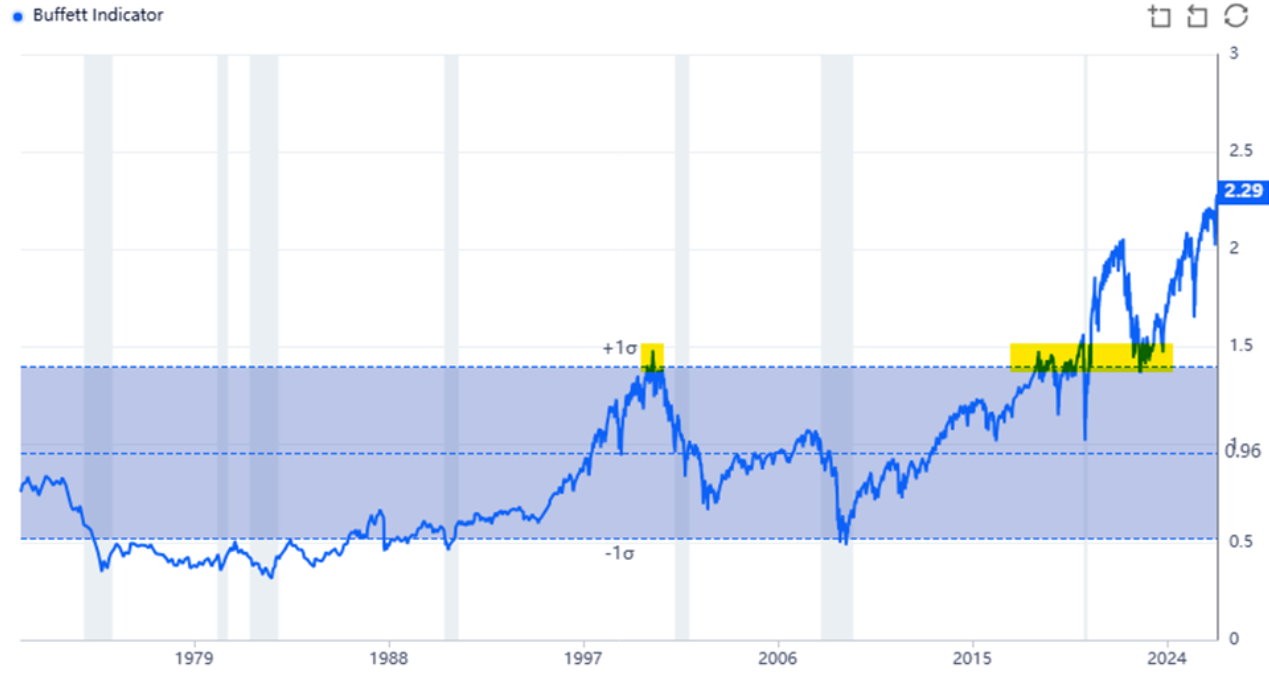
Source: GuruFocus
When investors are caught up in a frenzied environment such as the one we find ourselves in, holding cash is the furthest thing from their mind. It is at that point when “cash is trash” that they should heed Berkshire’s message that “cash is king.” Berkshire has looked foolish in the past, but when the dust settles, they are happy to deploy capital at compelling valuations. Nothing foolish about that.
What to Look for This Week
(All times E.S.T.)
- Friday, May 8 at 8:30 a.m. April Nonfarm Payrolls. With no net growth in the labor force, large swings in either direction may become the norm rather than the exception. The entire week is full of employment data: Tuesday, May 5 at 10:00 a.m. JOLTS for March; Wednesday, May 6 at 8:15 a.m. ADP National Employment Report; Thursday, May 7 at 8:30 a.m. Initial Claims for the week ending April 25.
- Thursday, May 7 at 11:00 a.m. New York Federal Reserve Survey of Consumer Expectations for April. We will key in on Five-year Inflation Expectations, which matched its March 2022 high last month at 3.6% (the Survey started in January 2022). If it continues to rise in April, it will become a focus of the FOMC and could continue the bias away from easing.
- Tuesday, May 5 at 10:00 a.m. ISM Services PMI for April. March came off versus February, which hit the highest level since August 2022. We will look at the Employment subsector because March saw the first drop in four months. Importantly, Prices rose to the highest level in three and a half years (we would like to determine if higher oil costs are spreading) and New Orders hit highs not seen in three. Supplier Deliveries dropped and any continuation could indicate extended supply chain problems.
FOMC Voters Speaking: Highlight of the week: Thursday, May 7 when two of the three forward guidance dissenters are scheduled to talk together at a fireside chat: Minneapolis Fed President Neel Kashkari and Cleveland Fed President Beth Hammack at 1:00 p.m. and 2:05 p.m. NY Fed President John Williams speaks afterwards at 3:30 p.m. on Thursday, May 7, and is also scheduled to give remarks on Monday, May 4 at 12:50 p.m. Tuesday, May 5 at 10:00 a.m. Vice Chair for Supervision Michelle Bowman speaks followed by the former Vice Chair Michael Barr at 12:30 p.m. on banking regulation. Friday, May 8 at 5:45 a.m. Governor Lisa Cook speaks on asset tokenization, and late Friday at 7:30 p.m. Fed Governors Christopher Waller and Michelle Bowman speak at a Stanford Monetary Policy Conference with Austan Goolsbee of the Chicago Fed and Mary Daly of San Francisco.
The Fed Senior Loan Officer Survey for Q1 2026 is released on Monday, May 4 at 2:00 p.m.
Earnings: The heavy calendar continues. Monday, May 4 after market we hear from Palantir Technologies Inc. (PLTR). KKR & Co. Inc. (KKR) reports before market on Tuesday, May 5 and we are expecting the theme to be “Private Credit is fine” but wonder if discussion turns to industry portfolio losses. Tuesday, May 5 after market Advanced Micro Devices, Inc. (AMD) reports after a 75% stock rise since March 30; we note that their Chief Technology Officer has been a large and impatient seller of stock in April (albeit not a major percentage of his holdings). Apollo Global Management, Inc. (APO) before market on Wednesday, May 6 for any developing themes with KKR. After market on Wednesday, AppLovin Corporation (APP) is expected to double earnings and our interest is if they describe Anthropic as a boon or a bane to their operations. Shell PLC (SHEL) earnings can provide a picture of the European supply shock before market on Thursday, May 7.
By Peter Corey
Risk Disclosure & Disclaimer
Copyright © 2026 Pave Finance, Inc., LLC and Peter Corey. All rights reserved.
The attached material is provided in partnership with Pave Investment Advisers, LLC (“Pave”), and is the opinion of Pave and Pave’s Chief Markets Strategist, Peter Corey. Distribution is being provided through a licensing agreement, and any further dissemination is strictly prohibited.
You are receiving this email because you opted in through our product or website.
You can update your preferences or unsubscribe from this list.
For Financial Professional Use Only
The content is developed from sources believed to be providing accurate information. The information in this material is not intended as tax or legal advice. Please consult legal or tax professionals for specific information regarding your individual situation. The opinions expressed and material provided are for general information and should not be considered a solicitation for the purchase or sale of any security. There is no guarantee any investment recommendations will be successful and there is a risk of losing money.
We take protecting your data and privacy very seriously. Please see our privacy policy here.
Pave Investment Advisors, LLC is an SEC Registered Investment Advisor. Such registration does not imply any level of expertise.
Securities offered through Pave Securities, LLC – New York, NY. Member FINRA/SIPC. You can review Pave Securities LLC with FINRA’s BrokerCheck BrokerCheck.
Advisory Services are only offered through Pave Investment Advisors, LLC., an SEC Registered Investment Advisor which is an affiliate of Pave Securities, LLC.
Pave Securities, LLC and Pave Investment Advisors, LLC do not offer tax or legal advice.
The news, resources and articles available on this site are being presented for educational purposes only and should not be considered specific investment or planning advice applicable to each individual.