Growth Runs Hot, Yields Follow

Wednesday's S&P Global flash PMI showed U.S. business activity expanding at the fastest pace since 2021. The bond market took notice as yields rose across the curve and high yield bonds hit 52-week lows, while the S&P 500 held within about 1% of its highs. This week we look at what moved and what Pave’s models are seeing underneath.
Hot PMI puts pressure on bonds
The September flash PMI was read as a signal of strong growth and sticky inflation. The report pointed to strong new orders and rising input costs, and S&P Global noted increasing supply-chain bottlenecks, labor shortages, and renewed pricing power for businesses.
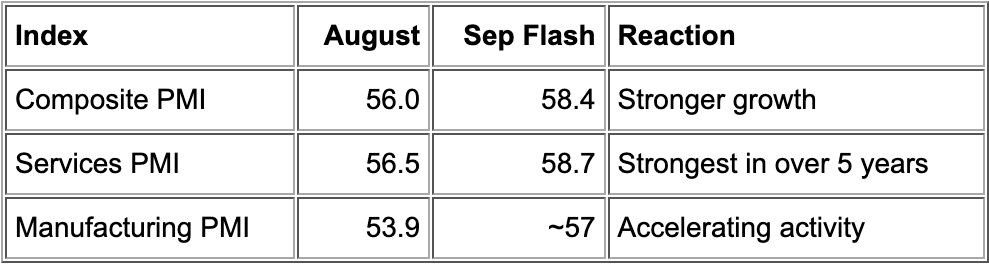
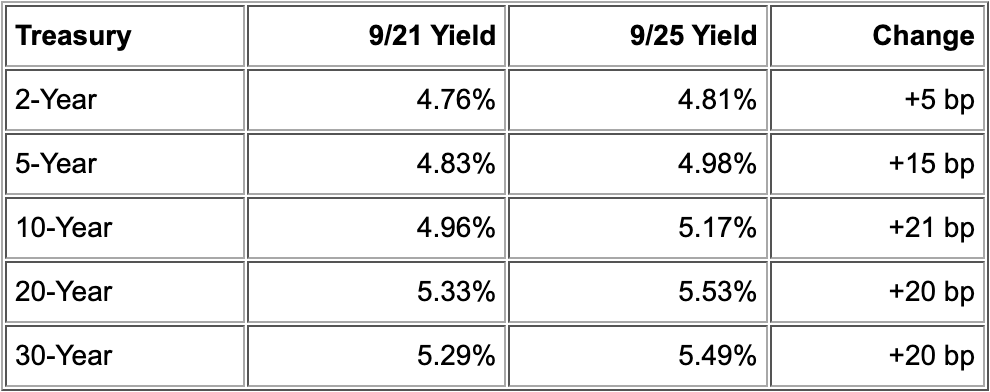
The message to investors was that economic growth remains very strong, inflation pressures are re-emerging, and the Fed may need to hike further or keep rates higher for longer. October hike odds rose about 18 percentage points, from 55% to 73%. On the day, the 5-year moved most, rising 15 to 20 bp. The 5-year is much more sensitive to the path of Fed policy over the next few years than the 30-year is. The 30-year cares more about long-run inflation and growth trends, which are stickier and less reactive to any single data point or auction.
For the week as a whole, the 2-year rose only 5 bp. That suggests the market was also repricing longer-term inflation and term premium on top of more Fed hikes, which is why the 10- to 30-year sector sold off much harder than the front end.
Nearly every bond category with meaningful duration sits in Pave’s bottom quintile. Intermediate Treasuries ranked lowest among Treasuries, in Pave’s bottom decile and below long-dated Treasuries (20th percentile). One explanation for a long-end selloff is fiscal: if investors lose confidence in the U.S. as a borrower, that fear compounds over time and should hit 30-year bonds the hardest. Pave’s models do not support that read, however, and point to a broad repricing of duration across fixed income. Municipal bonds also ranked near the bottom, though they held steady last week while taxable bonds slipped further. Emerging market debt and preferreds slid as well, consistent with a stronger dollar and pressure on rate-sensitive corners of the market. One area of fixed income that is seeing improvement are T-bills, which climbed from the bottom quintile to the top third over the past two weeks.
High yield's slide is a Treasury story
HYG trading at 52-week lows with the S&P 500 only 1% from its highs drew media attention last week. While this sounds worrisome, a closer look shows the majority of the decline coming from repricing in the Treasury market rather than a deterioration in default expectations. See the high yield spread to Treasuries: ICE BofA US High Yield Index Option-Adjusted Spread (BAMLH0A0HYM2) on FRED. Pave’s models agree, with high yield bond funds ranking in line with Treasuries of similar duration.
Credit spreads warrant some caution as well, but for now the stress remains contained to bonds further down the credit spectrum. Yields on CCC-rated bonds, the weakest borrowers, hit 11% last week, the highest since April 2025, a direct result of 5% Treasury yields. Stronger borrowers were able to borrow longer at lower rates in recent years, while less secure borrowers have to refinance at current rates. Pave’s models show early signs of the same pattern, with leveraged loans slipping last week and regional bank funds falling from 77th to 53rd percentile in the model’s ranking. CLOs still scored well, but with some of the thinnest market consensus in fixed income. Watching for this to move up the credit spectrum is worthwhile.
Growth is absorbing higher rates, for now
For now, the market looks poised to absorb higher rates thanks to strong growth. Tech has been the leading sector in September, with the Nasdaq at or near highs on strength in large caps. Tech stocks, particularly those valued on future growth, are often viewed as long-duration assets. Higher rates should weigh on them, but strong growth is outweighing the rate pressure so far.
Pave’s models are reflecting the tech strength. U.S. technology was the most upgraded sector in the readings, led by semiconductor equipment, with upgrades reaching mid- and small-cap tech. Broad large-cap growth and quality funds ranked near the top of Pave’s universe with strong consensus behind them. The narrower semiconductor and software corners also scored well, though consensus there is much thinner. On the other side, utilities, the classic bond proxy, fell to the bottom of the rankings, and REITs and homebuilders remained in the bottom third. The dollar held in the top quintile as the euro slid. Pave’s models were also not reaching for inflation hedges, as oil fell from our 94th to 54th percentile last week, with gold sitting near the 30th.
By Stephen Evans, CFA
Risk Disclosure & Disclaimer
Copyright © 2026 Pave Finance, Inc. and Stephen Evans. All rights reserved.
The attached material is provided in partnership with Pave Investment Advisors, LLC (“Pave”), and is the opinion of Pave and Pave’s Chief Investment Officer, Stephen Evans. Distribution is being provided through a licensing agreement, and any further dissemination is strictly prohibited.
For Financial Professional Use Only
The content is developed from sources believed to be providing accurate information. The information in this material is not intended as tax or legal advice. Please consult legal or tax professionals for specific information regarding your individual situation. The opinions expressed and material provided are for general information and should not be considered a solicitation for the purchase or sale of any security. There is no guarantee any investment recommendations will be successful and there is a risk of losing money.
We take protecting your data and privacy very seriously. Please see our privacy policy here.
Pave Investment Advisors, LLC is an SEC Registered Investment Adviser. Such registration does not imply any level of expertise.
Securities offered through Pave Securities, LLC – New York, NY. Member FINRA/SIPC. You can review Pave Securities, LLC with FINRA’s BrokerCheck.
Advisory Services are only offered through Pave Investment Advisors, LLC, an SEC Registered Investment Adviser which is an affiliate of Pave Securities, LLC.
Pave Securities, LLC and Pave Investment Advisors, LLC do not offer tax or legal advice.
The news, resources and articles available on this site are being presented for educational purposes only and should not be considered specific investment or planning advice applicable to each individual.